Showing posts with label algae and fungi. Show all posts

Friday, September 14, 2012

Science Week 6: Parasites and Nitrogen

This wraps up the first 6 week section for our science year already. This unit on Algae and Fungi was fun, and I'm sure as autumn creeps in and our woods become a bit more inviting (read: a few less snakes, ticks, and bugs etc...), we'll go back through those mosses and lichens. With near 20 acres out here of mountain nothingness, we have a wide assortment of them for study.

Onward to the parasites and nitrogen traps...commonly known types like ringworm and athlete's foot, mildews, rusts, and blights, even a less commonly known variety of parasite known as smuts. So, this week's notes:

  • fungi are thallophytes which are....plants without true roots, stems or leaves.
  • a fungus that lives on dead plant or animal material is a...saprophyte.
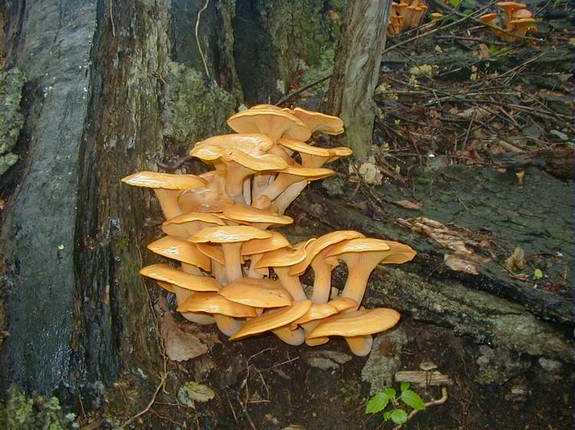
  • most gilled mushrooms are saprophytes. Nearly every gilled mushroom is found growing on the ground, rotted logs, rotting stumps, even dead limbs on living trees. Less than 1-in-20 mushroom species grows on living wood.
  • Saprophytes are soil builders. They change dead plant/animal material into carbon dioxide and simple elements. This is only one class of fungus...the other class is called parasite because they live off live plant and animal material.
Experiment 
"Bracket" or "shelf" fungi can be found in wooded areas growing on the sides of trees, fashioning themselves as little shelves, perhaps for elves! Fungi do not photosynthesize, as do other plants. They get their nourishment from a host they live on. If a plant gets its nourishment from a host organism that is dead and decaying, it is called a saprophyte. If the host is a living organism, the feeding plant is called a parasite.Are bracket fungi saprophytes, parasites, or both?Trees have tiny tubes that transport water, nutrients, and waste throughout their system. These tubes are called xylem (which transport wastes) and phloem (which transport food). Trees grow from the outer layer just beneath the bark. The bark is not living. Our project is to locate bracket fungi and carefully chip away at the bark of the host tree and see if any "roots" or threadlike structures penetrate through the bark and into the live layer of the tree. If this is the case, then bracket fungi is most likely a parasite. If not, it is most likely a saprophyte.Procedure 
In a forest or wooded area, locate trees on which bracket fungi are growing. Using a chisel, carefully pry pieces of bark off the tree around the bracket fungi. Try to determine if any part of the fungi extends through the bark and into the soft, live layer of the tree. To avoid injuring the tree, do not remove too much bark.
Carefully search through a large area in the forest, noting any presence of bracket fungi. Are the trees where you find the fungi dead or alive, or do you find them on both dead and live trees?       
from Education.com

  •  Fungi are not the only parasites...any plant or animal that grows on another living species or hinders it by taking food, shelter or water is known as a parasite. When one is helped and the other is harmed, it is a parasitic relationship. When each one helps the other it is a symbiotic relationship.
  • Mildew...a whitish grayish fungus seen on the leaves of roses, lilacs, and other plants. Some mildews cause damage, some do not. When the Hebrews were unfaithful to God, He punished them by sending mildew on their crops (Amos 4:9, Haggai 2:17
  • smut is another fungus that grows on plants, commonly ears of sweet corn (appears as clumps of gray swollen cells). The spores spread, blow, and remain in the soil to infect the next season of young crops. Wheat, barley, and corn are all food for smuts.
  • Rust also destroys wheat, oats, barley, and other cereal grains. The red spore stage causes an appearance like rust.  The stem and leaves of a wheat plant become red in the spring, then turn black in the late summer and fall. 
Picture of leaf rust on wheat
  • the black wheat spores can winter-over on the common barberry plant. They form tiny cups on the undersides of the leaves, and in the spring the red spores are developed again and infect the nearby wheat plants.
  • white pine blister rust is white and infects the white pine and wild current bushes.
  • Cedar apple rust lives on the red cedar part of the time, and on apple trees the remainder of the year.


  • All living things must have nitrogen in some form. If nitrogen is absent, life is impossible.
  • algae and fungi live in a symbiotic relationship in lichens, certain bacteria have a symbiotic relationship with lentils, clover, vetch, soybeans, cowpeas, and similar plants. These bacteria grow on the young roots, taking from them food and water. The bacteria draw nitrogen from the air in the soil and mix it with oxygen and other elements to form a solid food used by the plant. Knots of nitrogen called nodules are produced. Later the roots and nodules decay, dissolve in water, and nourish other herbs or trees which in turn benefit man.
  • some soil bacteria do not grow on plant roots but do a similar work. This process is called fixation of nitrogen. This is God's way of providing plants, animals, and man with necessary food elements. 

Nitrogen-fixation process


Stand still, and consider the wondrous works of God....


Thursday, August 23, 2012

Science Week 3: Algae and Seaweed

new links added after publishing will be posted at bottom of post and highlighted in red...

We had fun with our mushroom lessons, but in the interest of moving along with school and not bunny trail terribly far this year, it's time for algae lessons.

Our verse this week for science is Genesis 1:31a...And God saw everything that He had made, and, behold, it was good.

Our notes this week:

  • Algae belong to a plant division called Thallophytes,. There are over 80,000 known plants included in this division, and our study is on the algae plants. Algae of this type have single cells that form the main body, or thallus. Some appear to have roots, stems, and even leaves, but these parts do not function as true roots, stems, or leaves.  Thallophytes have no tubes through which sap moves.
Classification of microorganisms
  • Algae plants contain cholorphyll. Sunlight or indirect light allows the cholorphyll to combine carbon dioxide from the air with water and minerals to produce food for the plant. This is called photosynthesis, which means "to put together in light". Because they need light, algae grows in shallow water, or in the upper layers of deeper water. Links on photosynthesis here.
Common names used to refer to algae include "seaweed" and "pond scum."
  • Many algae are covered in gel-like layers. Separate plants form sheets and clumps because their outer walls cling together.
  • Algae species (there are over 10,000 different kinds) are divided into four classes based on their color...blue-green, green, brown, and red.
Blue-green algae is found in salt and fresh water and cannot be seen without a powerful microscope. They can withstand heat up to 200*, drying, and freezing. Some species have been dried and re-hydrated after 70 years and were still alive. These plants grow on land if they have a water supply. Several rock terraces at Yellowstone National Park are colored by algae. Many simple blue-green algae increase by cell division. Each cell divides, grows larger and divides again. Entire colonies form, break apart, and continue to multiply.

Almost all fresh water is home to one or more species of green algae. Common names for these plants are water moss and pond scums. The smallest of these algaes are found among desmids which coats sticks, shells, and other objects. The bright green hairy growth in water tanks or streams.
Sea lettuce - Ulva lactuca/Blue Ocean Society


Stoneworts...no preview  
Nitella...no preview

Brown Algae live mostly in the ocean or on rock seashores between low and high tide marks.Their green cholorphyll is covered completely by purple-brown or golden-brown coloring. The largest brown seaweed is kelp that can grow up to 200 feet. One of the largest areas of brown algae, sargassum or gulf weed, is found in the Sargasso Sea area of the North Atlantic Ocean. The Sargasso Sea is a large, calm area of ocean amidst swirling currents of the Gulf Stream, which encompasses nearly 2 million square miles. It is estimated there is approximately 10 million tons of floats algae there, providing floating homes to crabs, shrimps, small fishes, and various other animals.
no preview

Another brown seaweed known as rock weed, grows along rocky shores and forms a thick cover.  This leathery plant can be up to 2 ft. long and usually has 2 branches. Brown algae grows only in salt water.
no preview

Red Algae are always found in ocean water. They prefer the warm temperate climate, but can be found in tidal pools and along coral reefs from polar waters to the tropical regions. They can grow at a deeper depth than the brown seasweeds. Many of these are finely branched and feathery. The green color of their chlorophyll is covered by bright red, purple, or shades of violet and rose.
no preview

Edible algaes...the people of Japan, China and Hawaii use more than 100 different kinds of seaweeds as food. In Japan they cultivate beds of algae covering 1000 acres and harvested 3-4 months later. In the United States, agar-agar from seaweed, is used to thicken soups and sauces, ice creams and desserts, even pastries. Canned fish is improved by adding agar-agar. Chlorella, when dried, tastes much like raw pumpkin or raw lima beans. High in vitamin value, chlorella is more than 50% easily digested protein.

Some links:
Here is a lab lesson on pond water 
Microbial Life has some pages/information on Red Tides, or red algae bloom
**Learn for Your Life has several nice pages of activities and experiments covering several topics
Smithsonian Institute pages on algae research


Friday, August 3, 2012

Science Unit 1: Algae and Fungi

*edited to add Week 2 notes 9-4-12


This year, as I mentioned earlier, we are using the textbook, God's Marvelous Works book 2 from Rod & Staff for our science core this year.

Our first unit, with 6 lessons, will be on Algae and Fungi. We are taking 1 week on each lesson, reading the text through, looking up information from various resources, adding to our notebooks with narrations, notes, and drawings over the week, and taking a test on Fridays, before the next lesson.

I will be adding/updating this post with notes as we go along thru the next 6 weeks of this unit with resources we find useful and other goodies as I find them. Please do share any resources, links, or books you might know of as well.


General Notes:
The Hiker's Notebook is a great site, full of information on a variety of nature goodies, including our algae and fungi lessons.
Fungi Flashcards from Quizlet
Handbook of Nature Study blog, of course!
Michigan Morels has a great photo post of edible, or meadow mushrooms
poisonous and look-alike mushroom listing
Mushroom Appreciation site
Zen's WNC Nature Notebook, great information on plants as well as fungi of North Carolina
North American Mycological Association pages, lessons and ideas
A Fungus Among Us ebook
The good, The bad, and The ugly...a Purdue Ag Fun with Fungus in the Classroom study
Golden Acorn Homeschool blog sharing on fungi


Lesson 1: Mushrooms with gills
The Nature Photo site has some great pictures of gilled mushrooms, our first stop
a PDF describing gilled mushrooms and their identification
Mushroom Education workbook, a 53 page workbook for children from the American Mushroom Institute
Mushroom Fact Sheet pdf
Mushroom section
The Mushroom Journal, great photo plates and descriptions
click to enlarge and view

Week 2: Mushrooms without Gills notes:
  • pore mushrooms have small tubes, or pores, opening downward under the cap. Spores are formed inside and are shed thru the tubes. This group is call polypore, meaning "many pores"
  • Pine Cone mushroom is shaped like a meadow mushroom, but has a longer stem, and tufts on the blackish cap appear like scales on a pinecone.

pinecone mushroom
photo credit: M. Doran, ECOS  visit site for more great nature walk photos

  • Artist's Fungi grows as a bracket on oak or beech trees. Ranging from 2-8" across (some up to 2 foot), it is brown-gray and sometimes covered in rusty-brown spores. (a nice site with information and a slideshow of photos here) Each year a new ring of growth adds to the width and thickness. The spore tubes are pure white, but when they are injured they turn dark. A picture can be drawn on the underside by pressing with a pointed stick. Hard pressure produces a dark line, lighter pressure a more pale line. As the mushroom dries, the drawing becomes permanent.
photo credit: Altoon Sultan

credit: Cabin Creations of Maine visit site for some views of sketches on mushrooms!
  • rusty-hoof fomes (fom-mez) grow on beech, birch, and some other hardwoods, and may live up to 35 years. It was commonly used as tinder in early America.
Fomes fomentarius 7
Tinder Fungus refers to a number of species of fungi that catch and hold coals very well.They are used for holding a coal for an extended period of time, so as to not have to go through the effort of restarting a fire. Simply pry off a chunk of the smoldering Tinder Fungus and use it to light some tinder and remake your fire.They are also used to initially catch sparks in certain fire-making methods, such as the fire piston.Please note that the names of "True Tinder Fungus" and "False Tinder Fungus" will vary from region to region, and also depending on your context. For example, from a mushroomers point of view, naming Chaga (Inonotus obliquus) as tinder fungus is incorrect. A common name would be either chaga or clinker polypore; and that which is identified on this site as false tinder fungus is the true one! In any case, chaga makes a great tea with anti cancer properties. Fomes fomentarius the tinder polypore is also medicinal and can be used to make cloth or paper. (Thanks to David Spahr www.mushroom-collecting.com for this info!)
Identifying a true 'tinder fungus' 
polypore fungi and primitive firestarting

  • Hydnum repandum has a spore scatterer, white or buff in color, with a smooth cap as wide as 8" across, and an off-center stem less than 2" long. 
Hydnum umbilicatum


  • Puffballs have their spore-producing organs covered by a tough, sometimes papery, covering. Giant Puffballs can grow to 20" across (with record-holders up to 6 ft. across and weighing 60lbs!)  A Puffball weighing 5lbs can produce over 7 trillion spores, each in turn with the potential of producing 5 lb puffballs containing 7 trillion spores...in a mere 3 generations of Puffballs, they would produce a mass of mushrooms 800 times the size of our entire planet!  
  • Puffball spores mature and release from small tears in their covering. Every disturbance...a bird lighting to rest, a squirrel scampering past...sends up tiny clouds of smoke (spores).
  • a Bird's Nest Puffball grows on decaying wood and is a tan cup-shaped lower portion as large as 1/2in wide holding several white, egg-like spore balls, each fastened to the cup by a thread. 
Image - Photo of the edible Purple-spored Puffball (Calvatia cyathiformis)

A. Crucibulum vulgare, B. Nidularia candida, other species of bird's nest fungus with eggs
  • Earthstar mushrooms grow on bare soil. They are dark gray in the center, with from 7-20 papery 'petals' surrounding the 1-2" dry center. They measure water in the air...when there is low air moisture, the petals close around the center ball. When there is higher moisture content, the petals open. During very high moisture times, the petals may curve completely backwards and extend under the center ball, lifting it so as to resemble a standing man.
  
credit: via Google Images


edited to add new link (9-3-12):  This is a nice General Botany site with some good information we have used, as well as several graphics we printed off for the notebooks.
some neat notes and a few images on Fungal Biology
The Fungus Among Us museum interactive
Life The Science of Biology section of tutorials and activities on fungi
BJU Press General Science links