Can you believe some folks simply don't SEE God in nature around them? Everything has been designed with such order, and yet it still eludes so many people as to the fact it actually has been planned out, designed for a purpose.
God has, in His Divine Wisdom, placed trees, reptiles, birds, fishes, mammals and such into groups together, into habitats where each depends on the other to varying degrees for food, for shelter, for life. Too often, man determines that this Plan is wrong, and starts to take matters of design into his own hands, redesigning the habitats of all around him. Man decides one day that he alone, being a higher creature, has the right to be a predator. The predatory animals, he determines, are greedy and blood-thirsty. He alone should have the free reign to hunt other animals. So he sets about to put his own plan into motion.
In 1906 the Grand Canyon National Game Preserve in Arizona sheltered 4000 deer. State Game officials determined that many more deer could, and would, live in this area if predators were removed. They closed all deer hunting for a time. Then they instituted a paid hunt program in which men were paid a designated price for each large predatory animal killed. Records show that up until 1924, 4889 coyotes, 781 cougars, 30 wolves, and 554 bobcats had been destroyed because of this paid hunt program. In 1916, 30,000 deer were living in the protection of the forest. Two years later, 40,000 were roaming the game preserve, and by 1924 there were close to 100,000. The plan to increase the deer population, and decrease the predator population was a success...right?
Because of the increase in deer, young saplings and new shoots were devoured, larger trees died as hungry deer chewed off bark and dug up roots in effort to stay alive. Erosion of the bare slopes began. In truth, the whole of the countryside looked as though it had been devoured by a swarm of locusts. Over 40,000 deer died from starvation and disease during the next 2 winters. Tens of thousands died until the herds of deer numbered only 10.000, and many of these were quite small and weak. Even with just 10,000 deer on the acreage, the food supplies remained scarce. Other populations suffered as well. The cougars, wolves, coyotes, and bobcats had not only prospered the deer, they had also protected the vegetation and trees the other animals were dependent on.
God's Wisdom created groups of animals and placed them together into habitats to be useful, even beneficial, to one another. Mans efforts to reorder the Master Design all too often appear to be working, but in time prove to be failures, often to the point of extinction of certain animal and vegetation.
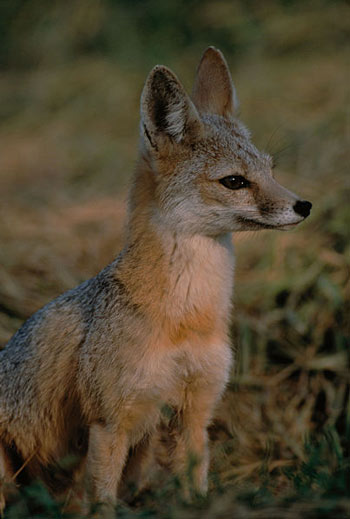
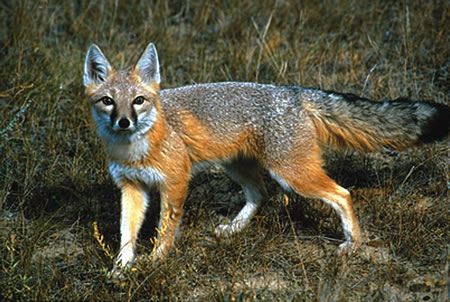
Carnivores, or meat eaters: the smallest of these studied so far has been the kit fox, that weigh in at only 4-6 lbs. The weasel, tiniest of all, weighs less than an ounce. Long and slender in body, round ears, short legs...

photo credit: Chris Beever
Weasels are known for the beauty and softness of their brown fur, and for the little bags of musk carried in glands under their tails. Weasels living in the north lands turn white almost overnight when the first snow falls. Brown hair is shed and white grows in its place. This snowy plush fur is known as ermine. In Europe weasels are called stoats. Their pelts often trim very showy clothing.
Weasels move quickly, and continually. Heartbeat, breathing, and digestion are fast and much food is needed to sustain them. Dogs and cats may maul, or play, with their prey, but weasels are hungry all the time. They kill their food at once. Weasels may store piles of dead mice in their burrows or under leaf litter. Shrews, moles, and nesting birds are also taken. White-footed mice and meadow voles (nice PDF here) make up 50-80% of the weasel's diet.
The Slinky, Stinky Weasel Family, from The Young Naturalists check out the sidebar for some great printable teaching resources too.
Weasels, from ThinkQuest

photo credit: Free-Extras
The most common and well-known member of the predator weasel family is the skunk. There are 6 species of skunk found in the United States, Mexico, and Canada: eastern spotted, western spotted, hog-nosed, eastern hog-nosed, hooded skunk, and the striped skunk. The fur of these creatures, both natural and dyed, are highly sought after.
Skunks eat hoards of crickets, grasshoppers, and beetles. These slow animals den under sheds and barns, finishing off their mouse populations. In New York State, the skunk is protected for the sake of the hop crop that is eaten by a grub that the skunk likes to feed on. All in all, skunks are said to destroy more insects than all other kinds of mammals combined.
All skunks carry the bags of musk common to weasels. However, they have spraying muscles that other weasels don't have.
Skunk Spray, a chemical called N-butlymercaptan, is a volatile mix of sulfur-containing compounds. The skunk produces and stores these chemicals in a pair of glands on the lateral sides of its anus. It stores enough for roughly 5 sprays, and it will need more than a week to produce more. The spray can reach almost 15 ft with impressive accuracy. The victim will not only succumb to the smell, but may also xperience temporary eye irritation or blindness. It is an effective defense that keeps all but a few sneaky predators away.
Skunk Facts National Geographic, and National Geographic Kids
skunk printable, Enchanted Learning

photo credit: The Independent
The low, wide, powerful clawed badger is among the best digging mammal in the United States. Underground, in burrows, the badger has the ability to catch any creature it smells because it can dig faster than any other animal can. Badgers dig complicated burrows with sleeping and eating rooms where carrion is often stored. Several generations of badgers may live in the same maze of tunnels as long as food is plentiful. The mothers care for the young, while the fathers do not usually stay with the families. Like skunks, badgers grow fat in the autumn, but they do not hibernate, although they will sleep for extended periods of time during the winter. They have grown more scarce than they once were due to their main food source, prairie dogs, being decreased in population. Eagles or coyotes carry off young and small badgers, and larger predators, such as cougars or wolves, sometimes succeed in killing full-grown badgers.
American Badger, Nature Works
Badger printable, Enchanted Learning

photo credit: Matthias Kabel, The Animal Files
The wolverine is the largest of the weasel family. In disposition, it is more like the weasel than the skunk or the badger. They may roam over 100 miles in search of food sources. They look like a small, chunky bear, and their muck glands carry scent as powerful as that of the skunk. In fact, their nickname is skunk bear.
Once, a group of men on Mount McKinley in Alaska, discovered where a wolverine had killed a Dall's sheep, weighing about 150 lbs, and had carried the sheep a mile and a half, down the mountain and across a river, before climbing a steep bank with it and beginning to eat it. Not only is the wolverine known for its unusual strength, it is also very fast and can easily run down a moose, deer, or hares. When chased by wolves, it can easily leave them far behind. It is also a strong swimmer and can cross lakes and rivers to search for or follow food. It is also a skilled climber. Sometimes wolverines retreat before bears or packs of wolves come, other times they will remain and fight without fear, chasing off cougars, bears, wolves, or coyotes from food they want for themselves.
Wolverines, like others in the mustelid family, have valuable fur. Moisture will not freeze on wolverine fur, and it is usually cut into large strips and used to line the opening of parka hoods. Arctic travelers have always preferred wolverine fur for this reason. Skiing and winter sports created a larger demand for the wolverine-lined hoods as well.
Wolverine Fact Sheet, Defenders of Wildlife
Endangered Species: Wolverines U.S. Fish & Wildlife Services